GROOMING YOUR PARROT
Grooming your parrot is a very important part of keeping your pet. Long beaks and nails not only hurt the owner, but can get hooked in toys, furniture and carpeting with dangerous results. Wings need to be kept in check always to prevent bird loss or tragic parrot accidents.
WINGS
TheParrot Rehabilitation Society recommends strongly that its members keep their parrots wings clipped. We feel so strongly about it, in fact, that it is a requirement in our parrot adoption contract. An unclipped bird is far more likely to get lost and become another tragic story of a friend lost forever. Not only that, a parrot flying around the house can hit a window, a ceiling fan, a burning stove or oven or a host of other household dangers. Needless to say, the results could be tragic. In the wild, parrots fly to food or friends. Our domestic psittacines are provided with both. They learn very quickly to maneuver efficiently on their two powerful legs, and, as owners soon realize, are able to get almost anywhere they please just by walking and climbing. Wing clipping is as painless as cutting hair (and even more temporary) and causes no discomfort to the parrot, save the indignancy of being held in a towel during the process.
There are a few methods of wing clipping. The traditional approach is the the safest. It involves cutting the first 8-10 primary flight feathers. When the bird closes its wings, it is very hard to tell that the bird is clipped at all (unless you know what you're looking at). The flight feathers that remain allow the bird just enough glide that if he were to jump off a perch, etc., he would not fall like a rock, but be able to land on his feet.
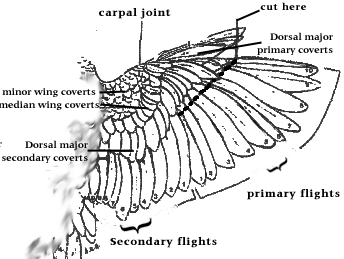
 When clipping a bird's wing, the feathers we are concerned with are the Primary Flight Feathers (the long feathers at the end of a bird's wings which provide propulsion), the Secondary Flight Feathers (the shorter feathers located between the primaries and the bird's body. These provide lift, but do not work without propulsion), and the Primary Covert Feathers (located just cranial to [above] the Primary Flights, these will act as a "dotted line" for cutting the Flight feathers along.) Please refer to the diagram
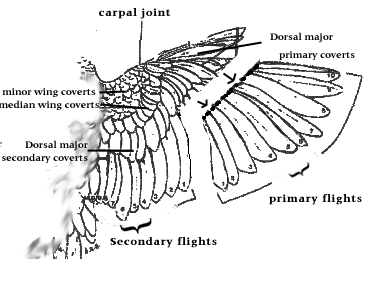 In cutting a bird's wings, we cut the first (outer) 8-10 Primary Flight Feathers. ALWAYS aim the scissor tips away from the bird's body!!! For safety purposes, we do not clip the Secondary Flights (this may lead to a cut blood feather and/or discomfort to the bird). When cutting the Flights we can use the Primary Coverts as a "dotted line" type guide. That is, we never cut higher (towards the head) than the primary covert feathers. The idea is, that in the event of a "blood" feather (immature feather), the blood supply will end before the growing feather reaches the end of the coverts. Therefore, if we cut below these feathers, no blood supply will be hit.
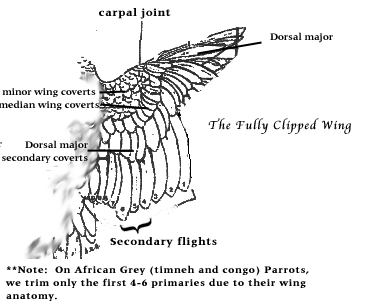 Clipping the feathers in this manner eliminates the bird's means of propulsion (primary flights). Without propulsion, a parrot's means of air lift (secondary flights) is rendered inoperative. Thus, this safe and painless meathod of wing trimming allows the bird enough support to glide to the ground and land on their feet, while denying them the airial lift which could end tragically. We recommend trimming both wings! A bird with only one wing trimmed could get enough lift to put him into a spiral, where he has little control of his destination.
This method of clipping is the most sure-fire as well as the fastest and simplest. It is strongly recommend for adult bird safety. Other methods of clipping are done by some groomers and provide no advantage but asthetic. They are called "window clipping" (leaving the first 2 flight feathers), and "alternate feather clipping" (clipping every other feather and crescent shaping the remaining ones). Not only do these methods take longer, but many birds can fly with these clips. Parrots are powerful fliers, their thin, long aerodynamic shapes allow them lift and flight even lacking feathers. All a bird has to do is fly to the nearest tree, and he may be lost forever. While these clips may leave the parrot looking more "wild" the possibility of loosing your favorite feathered friend is a far more important consideration.
If you are interested in learning to trim your bird's wings yourself, make sure a professional shows you how it is done first. Also, ALWAYS aim the scissor tips away from your bird's body!!! PRS conducts several seminars a year dealing with grooming, and it would be very beneficial to attend whether you want to learn to do it yourself, or just want to see it done.
NAILS
It is important to keep your bird's nails in top shape. Long nails can get hooked in toys, cages, carpet or furniture. This may result in a broken toe or leg. Not to mention that long nails hurt! The bird's nail is, like our nails, dead at the tip but containing within a sensitive "quick" that bleeds. If you have never clipped your bird's nails before, have somebody show you first. When you clip your bird's toes have a styptic powder or liquid on hand to stop accidental bleeding. These can be bought at any pet store. Keep a careful eye on the bird's other toes, which they tend to wrap around the nail clipper and may get cut in the process. Finally, if the toe you are trying to clip is cramped in a first, do not pull too hard on it to get it into clipping position. There is a tendon that holds the nail in that position, and it can be perminantly broken if you pull on the nail too hard. Again, if you intend to trim your own bird's nails, be sure someone in the know shows you how it is done!
BEAK
While it doesn't happen as often as wings or nails, a bird's beak may become overgrown. Some parrots actually have beak growth problems where the beak may be malocclused, misformed or tended toward hyper-growth. These beaks require constant veterinary attention or grooming to keep them normal. Most parrots' beaks, however just require a little attention now and again to prevent it from becomming a dangerous weapon. Usually this is done with a nail file or a Dremel tool to grind down the end or smooth the layers on the sides. Under the hard exterior of the beak is sensitive, soft tissue. If nicked or buised during grooming bleeding may occur and sensitivity may result. Grooming the beak is important, but should only be performed by knowledgeable groomers.
Please visit our Calendar of Events
for information on upcoming grooming workshops!
© 1996 Papagalla Productions